
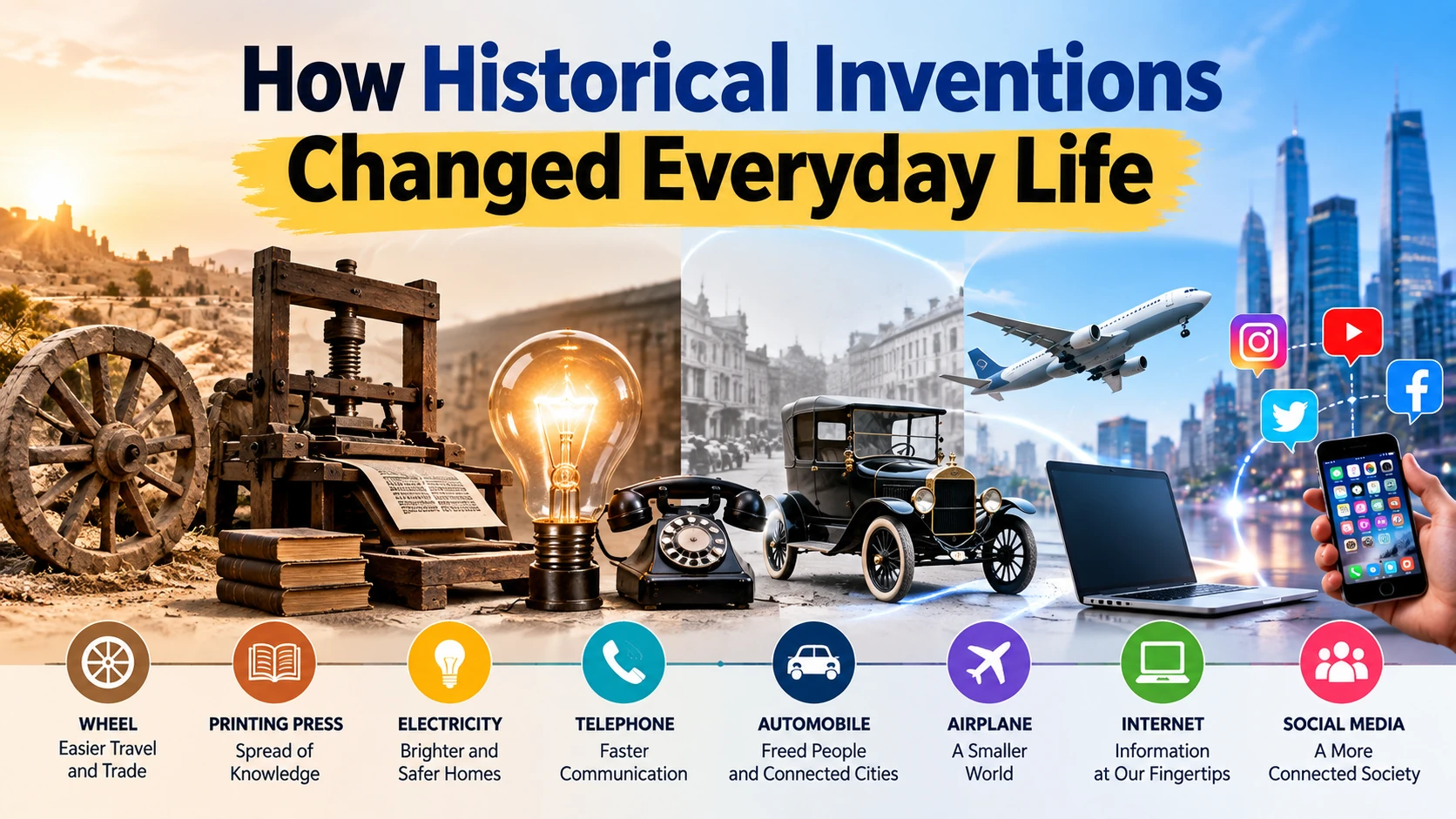
Many things people consider ordinary today are the result of inventions developed over centuries. Writing systems, paper, the wheel, printing technology, mechanical clocks, sanitation systems, and countless other innovations changed how people communicated, worked, traveled, learned, and lived.
Historical inventions did not always transform society immediately. Many developed gradually, were improved by different cultures, and became influential only after they were adopted on a wider scale.
The Wheel and Transportation
The wheel is one of the most influential technological developments in human history. Its early uses included transportation and mechanical applications.
Wheeled vehicles made it easier to transport people and materials in suitable environments. Over time, improvements in wheels, axles, carts, and vehicles supported trade, agriculture, construction, and travel.
The broader development of transportation technologies eventually helped connect increasingly distant communities.
Writing Changed Communication
Writing allowed people to record information beyond what could be remembered or communicated orally.
Early writing systems were used for purposes such as administration, trade, laws, religious texts, and record keeping. Written records allowed information to survive across generations and could be copied and transported.
Writing also supported the development of organized governments, commerce, education, and historical documentation.
Paper Made Information Easier to Preserve
The development and spread of paper provided a practical medium for recording information. Compared with some earlier writing materials, paper could be produced and transported relatively efficiently.
As paper became more widely available, it supported education, administration, correspondence, literature, and record keeping.
Its importance increased further with developments in printing.
The Printing Press Transformed Access to Information
Movable-type printing technologies dramatically increased the ability to reproduce written material in large quantities.
Printed books and pamphlets could reach much larger audiences than individually handwritten manuscripts. This contributed to the expansion of literacy and the spread of scientific, religious, political, and literary ideas.
Printing also made it easier for information to be standardized and distributed across regions.
The Compass Supported Navigation
Navigation was transformed by technologies such as the magnetic compass. A reliable indication of direction helped travelers navigate beyond familiar landscapes.
The compass became particularly valuable for maritime travel, although successful navigation also depended on maps, astronomical knowledge, weather awareness, and practical experience.
Improved navigation contributed to long-distance trade and exploration.
Mechanical Clocks Changed the Measurement of Time
Early societies had various ways of tracking time, including sundials and water clocks. Mechanical clocks provided increasingly standardized ways of measuring hours.
As mechanical clocks became more widespread, precise timekeeping became increasingly important for religious activities, commerce, transportation, work, and public life.
Modern schedules and time-based coordination have roots in this long history of increasingly precise time measurement.
Sanitation Changed Public Health
Advances in sanitation and water management had profound effects on urban life. Ancient civilizations developed drainage systems, wells, aqueducts, toilets, and other infrastructure to manage water and waste.
Much later, improvements in sewer systems, clean water supplies, and public sanitation became essential components of modern cities.
These developments helped societies understand the importance of environmental conditions for public health.
The Steam Engine Transformed Work and Transportation
The development and improvement of steam engines played a major role during the Industrial Revolution.
Steam power could operate machinery and contribute to transportation through steam-powered ships and locomotives. Factories could produce goods on a much larger scale than many earlier production systems.
This transformation also changed employment patterns, urbanization, transportation networks, and economic organization.
Electricity Reshaped Daily Life
The development of electrical technologies eventually transformed homes, businesses, factories, and cities.
Electric lighting extended productive and social activity beyond daylight hours. Electrical appliances reduced or changed the nature of many household tasks, while electric communication and transportation technologies connected people across greater distances.
The widespread use of electricity became one of the foundations of modern life.
Refrigeration Changed Food Storage
Modern refrigeration allowed food to be kept at low temperatures for extended periods. This affected household food storage, transportation, agriculture, restaurants, and retail.
Refrigeration helped make it possible to transport perishable foods across greater distances and maintain them for longer periods under appropriate conditions.
Final Thoughts
Historical inventions changed everyday life by gradually expanding what people could communicate, produce, transport, preserve, and understand.
From the wheel and writing to printing, navigation, sanitation, steam power, electricity, and refrigeration, technological developments often built upon earlier discoveries and improvements.
The modern world is therefore not the result of a few isolated inventions. It is the outcome of centuries of experimentation, adaptation, and knowledge-sharing that transformed ordinary activities into increasingly efficient and interconnected systems.